
Austronesian Sailing Course at National Taitung University: Learning History Through Sailing
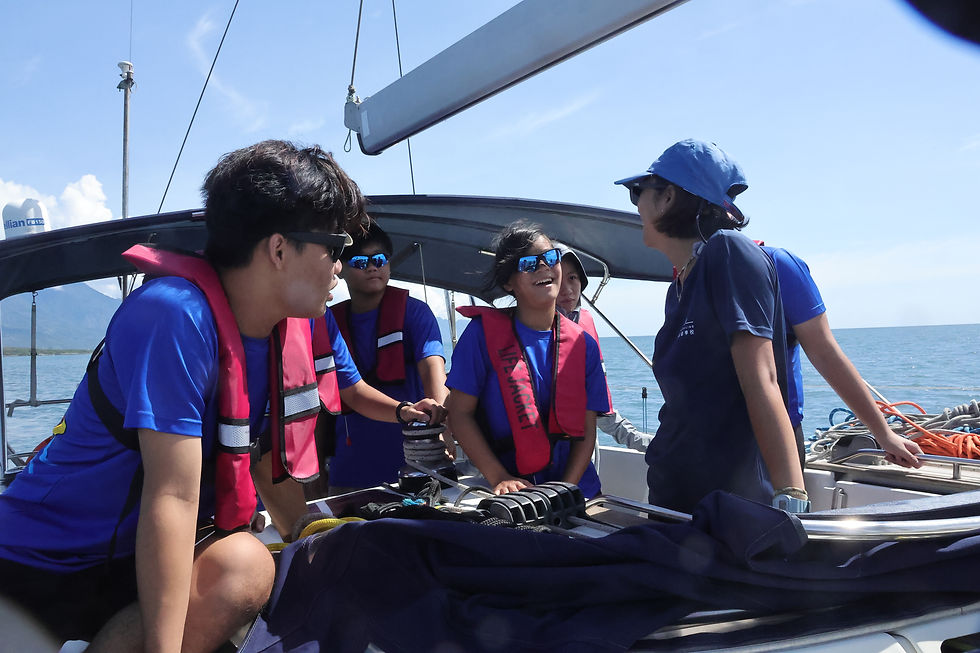
During April and May, it was a pleasure to work with students from the Department of Austronesian Studies at National Taitung University as part of a unique sailing program that combined practical sailing skills with the study of Austronesian migration and maritime culture.
The course brought together 10 master's and PhD students who are researching the origins, movements, and cultural connections of Austronesian peoples across the Pacific Ocean. While much of this research is often conducted through archaeology, linguistics, and anthropology, this program offered a different perspective: learning through direct experience on the water.

Understanding Austronesian Migration Through Sailing
For thousands of years, Austronesian peoples crossed vast stretches of ocean, settling islands across the Pacific and Indian Oceans. Their achievements remain one of the greatest maritime migrations in human history.
By participating in sailing courses, students gained a practical understanding of the challenges and skills that would have been essential for ancient navigators. While modern sailboats differ significantly from traditional Austronesian vessels, many of the fundamental concepts remain the same: understanding the wind, reading weather conditions, coordinating a crew, and making decisions based on the natural environment. In this way, learning to sail provides an opportunity for students to move beyond theory and experience some of these concepts firsthand.

Building Foundations: Boat Parts, Sailing Logic, and Hands-On Experience
The first session focused on introducing students to the structure of a sailboat and the basic logic of sailing. Students learned the names and functions of different parts of the boat, participated in rigging exercises, and spent their first hours on the water learning how sails and rudders work together to control direction and speed. For many participants, it was their first experience sailing. As they adjusted the sails and held the tiller, they began to appreciate how much knowledge and intuition are required to move efficiently across the water.
As the course progressed, students explored the scientific principles behind sailing. Topics included: wind direction and points of sail; sail trim and sail shape; the relationship between airflow and boat speed; Bernoulli's Principle and pressure differences around the sail; and the use of headsails to increase efficiency.
By combining modern sailing theory with practical exercises, students were able to connect contemporary scientific explanations with the remarkable achievements of Austronesian seafarers, who developed sophisticated sailing technologies through observation and experience rather than formal scientific models.

Learning Through Teamwork
One of the most significant lessons throughout the course was the importance of cooperation. As students progressed from beginner exercises to more advanced maneuvers, they learned that successful sailing depends on communication between crew members. Steering, trimming sails, and balancing the boat all require coordination and trust. With this in mind, the course gradually introduced more complex tasks, including precision turning exercises around buoys, crew position changes, and longer sailing routes across the lake.

By the final sessions, many students were capable of sailing independently. The course concluded with a practical assessment that challenged participants to sail longer distances across the lake while demonstrating their ability to rig a sailboat independently, tie essential sailing knots, adjust sails according to changing wind conditions, and maintain control of the boat throughout a complete sailing course.
Sailing as a Bridge Between Past and Future
One of the goals of this collaboration was to explore how modern sailing can serve as a bridge to understanding Austronesian maritime traditions. Rather than viewing ancient navigation solely as a historical achievement, the program encouraged students to experience some of the same challenges that sailors have faced for generations: interpreting the wind, trusting their vessel, and developing a deep awareness of the natural environment.
At our sailing school, we believe that sailing can be much more than recreation. Whether through youth programs, outdoor activities, or university partnerships, sailing provides a unique opportunity to combine practical skills with deeper learning. We are grateful to the students and faculty of the Department of Austronesian Studies for joining us on this journey and look forward to future collaborations that continue to connect maritime heritage with modern sailing in Taiwan.



Comments